


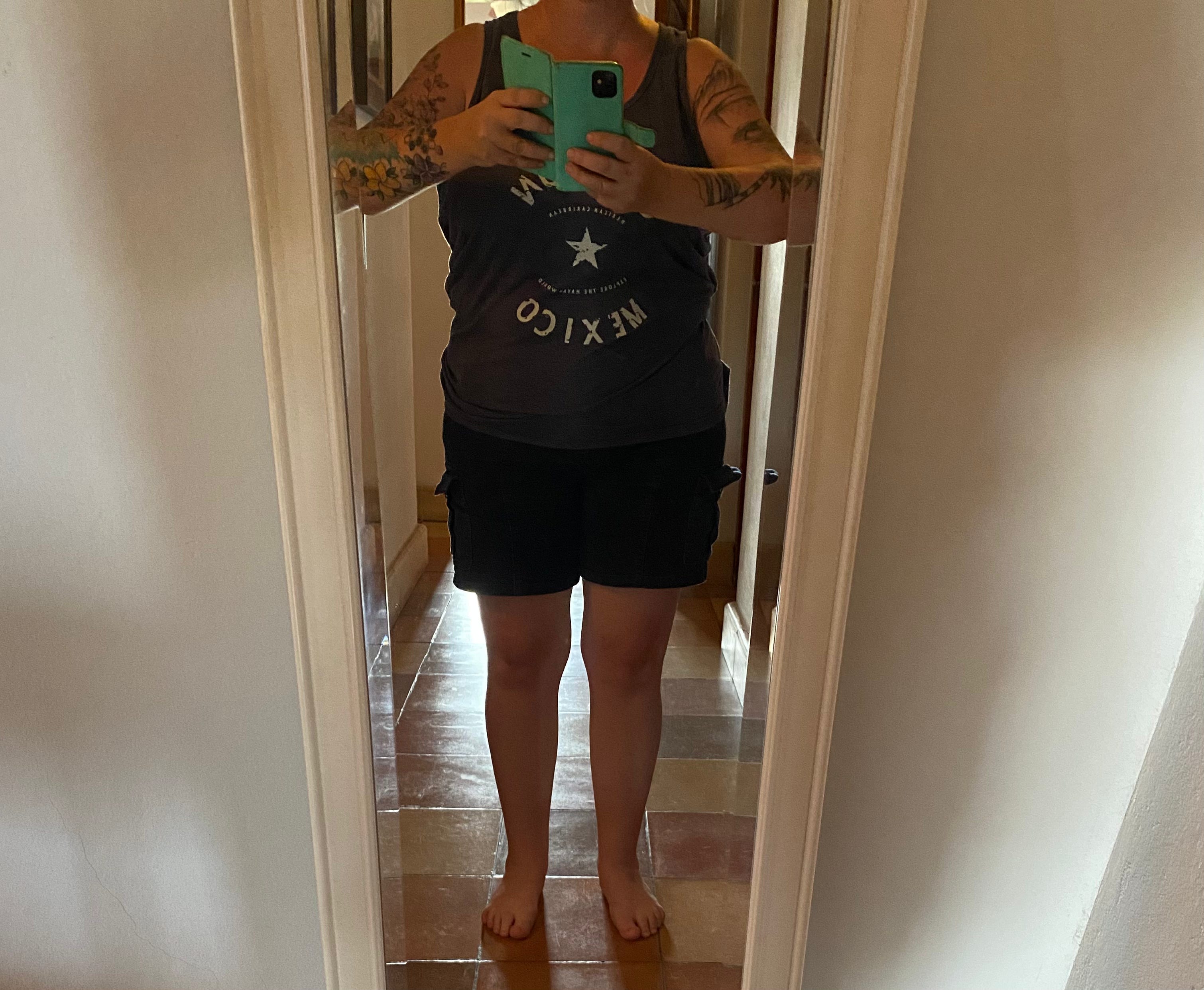
This won’t be my regular Monday motivation post. Typically, I like to kick off the week by sharing the story of someone who’s made big changes in midlife. Sometimes that’s a celebrity story, like this one on Viola Davis, or the story of someone I’ve met in our travels, like this one featuring the Chateau Gardener, Jen Bidding.
Today, I’m the one in need of a bit of motivation. And maybe a bit of a rant.
I shared a bit of this on Facebook last week, but it’s still chapping my ass. Those who’ve been reading a while may recall I’ve had some health problems in recent years. Some kind of inflammatory arthritis goblin really took it out of me for a couple of years and then last summer, in the investigation of crippling headaches I’ve been having, an MRI revealed a small brain aneurysm.
His name is Fred, and my primary goal in life now is not pissing him off.
Last month, I had a neurosurgery consult in Toronto to have another look at him and see whether Fred is good to stay put for a while.
The good news: no surgery on the horizon. The risk of having a stroke on the table if they try to repair Fred is higher than just leaving him alone, so we’re monitoring for now.
Fred came with a hypertension diagnosis, and this appointment produced more good news on that front. My blood pressure has come down to a consistently perfect 120/80, which I worked hard at with medication, monitoring, and lifestyle changes including a shit ton of stress management and changing up my diet and workload.
I quit smoking about 10 years ago, and that’s the other major risk factor they worry about with brain aneurysm.
I take the recommended supplements. I get a lot of protein. I’ve worked mobility, balance and strength training into my day in ways I don’t absolutely hate.
I switched from driving a car to e-bike and walking, unless I’m using Trevor’s when at the home base. I’m sleeping so much better. I’m on HRT and managed to skip most of the perimenopause monster thanks to adenomyosis treatment.
I have a good medical team and am actually getting preventative care.
Most days, I feel pretty lucky! I made it to 45 almost without major incident. Not many of them, anyway. I was born with a hereditary bleeding disorder, and there’s been so much progress on that front that unless I’m critically injured or having surgery (or like… an aneurysm rupture…) it’s very manageable.
The inflammatory gremlin has mostly been at bay for 2 years now (knock on wood). I can run up stairs, climb hills, and jump around.
Life is good.
And so imagine my surprise when, during this consult where we’ve just reviewed all the good progress, this doctor I’m meeting for the first time says I need to lose some weight or take a GLP-1.
Wait. Whut?
We just went over the indicators.
My A1C is good, I’m not pre-diabetic. My blood pressure is perfect. I’m still pretty strong… I have joint issues but could lift someone my own weight in an emergency.
I’ve always been muscular. In public school, I won shotput. In high school, I won bets carrying 200lb men. In young adulthood, I trained for the police physical and qualified for volunteer firefighting by deadlifting guys bigger than me.
None of that is to brag. It’s to say, the weight has a purpose.
And this is where BMI enters the chat — a number we’ve somehow allowed to become shorthand for health, despite the fact that it was never designed to measure an individual person’s health in the first place. Especially a woman’s health.
BMI comes from a formula developed in the 1830s by Belgian mathematician and statistician Adolphe Quetelet. He was studying populations and trying to describe the characteristics of the “average man.”
He wasn’t a physician developing a diagnostic tool.
His work was based largely on European men, not women, and certainly not on a representative sample of people across different ages, ethnicities, body types, or stages of life.
The formula — weight divided by height squared — was later adopted by researchers, insurers and public-health organizations because it offered a quick, inexpensive way to sort large populations into broad weight categories. Somewhere along the way, a population-level statistical shortcut became something doctors routinely apply to individual bodies.
And it’s a pretty blunt instrument for that job. BMI can’t tell the difference between muscle, fat and bone.
It doesn’t measure visceral fat, fitness, strength, cardiovascular health, blood pressure, blood sugar, cholesterol, diet, mobility or metabolic health.
It also doesn’t account particularly well for sex-related differences in body composition or the changes women experience with age and menopause.
That doesn’t make BMI completely useless… at a population level, very high or very low BMI is associated with health risks, and it can be one piece of an individual risk assessment.
But treating the number itself as a diagnosis of poor health is giving a 190-year-old statistical ratio considerably more authority than it deserves.
I mean, BMI says 170lbs for a woman my height is obese. I was 170lbs in my early 20s, in the best shape of my life. I’m 205 now, and my blood sugar, blood pressure, cholesterol etc and HOW I ACTUALLY FEEL say that’s where we want to be.
I don’t want to be a stick. I don’t want to feel frail. And I’m also getting sick and tired of judgment of women dressed up poorly as concern for our health when there’s no factual or scientific basis for it.
When it comes to GLP-1s in particular, I don’t ever want to take something that turns off my love of food. I fucking LOVE food. I trained as a chef, and then married one!
I truly enjoy cooking and eating, so if we’re going to take that joy out of my life and make me hate eating, there better be a damn good reason.
Why on EARTH is “lose weight or take a GLP-1” the first response to a BMI number, when every other health metric that matters says I’m doing alright?
GLP-1 medications can be genuinely life-changing for people who have diabetes, obesity-related disease, or other clinical reasons to use them. This isn’t an anti-Ozempic rant. If I need it, I’ll take it, and I have nothing but love for anyone who has gone that route.
But they’re prescription medications with real effects, real side effects, contraindications and trade-offs, and recommending one should follow an actual assessment of the person in front of you.
What is their waist circumference and body composition?
What are their blood pressure, A1C, lipids and other metabolic markers doing?
How active are they?
What medications and medical conditions might affect their weight?
What would losing substantial weight actually accomplish for this particular patient?
What risks are we trying to reduce here?
That matters even more as we get older, because weight loss isn’t automatically fat loss. GLP-1–associated weight loss can include loss of lean mass as well as fat, which makes adequate protein and resistance training especially important.
For a middle-aged woman who has spent decades carrying a fair amount of muscle, “the scale needs to go down” isn’t a sufficiently sophisticated treatment goal. Preserving muscle, strength, mobility and bone health matters, too (I’d even say it matters a hell of a lot more).
So I’m not arguing that my weight is irrelevant, or that carrying excess body fat can’t increase health risks. It can. Maybe after looking at the whole picture, losing some fat would improve my long-term risk profile, and maybe medication could eventually be a reasonable tool for doing that.
But that conversation should start with “What risk are we treating?” not “Your BMI says you’re obese; take this.”
I think that’s what has been bothering me for weeks. Not the suggestion that I could lose weight. I’m a grown woman with a mirror; this is not breaking news.
It’s that I walked into that appointment having done so many of the things we’re constantly told we should do for our health. I quit smoking. I got my blood pressure under control. I move my body. I lift things. I eat reasonably well. I manage my stress. I sleep. I take my meds. I monitor the things that need monitoring.
Somehow, after all of that, the number that seemed to matter was the one on the scale.
Women deserve better medicine than this.
Tell me my visceral fat is too high, or my bloodwork is heading in the wrong direction. Tell me there’s evidence that losing 20 or 30 pounds will meaningfully reduce the specific risk we’re worried about with Fred.
Hell, show me the evidence and I will probably become the most annoyingly compliant patient you’ve ever met.
But don’t look at my height and weight, run them through a formula invented by a Belgian statistician nearly two centuries ago, and call the resulting number a comprehensive assessment of my health.
I’m not interested in being thinner for the sake of being thinner. I’m interested in being healthy, strong, mobile and alive for as long as possible. BMI gets no seat at that table.
✌🏻 Miranda
P.S. Pangram said this was +50% written by AI. Pangram can get bent, and Substack for forcing this on us. I’m sick of being punished for using the same writing style I developed over 20+ years, which AI then trained on. /rant