


The most common household in Canada isn’t a couple. It isn’t parents with kids. It’s one person, on their own.
One-person households have been the single most common household type in the country since 2016, and by the 2021 census they made up close to 30 percent of all homes. Some 4.4 million Canadians now live alone, up from 1.7 million in 1981. It’s often assumed to be a story about aging, and partly it is. But it’s happening in the middle of life too — the share of people aged 35 to 44 living alone doubled between 1981 and 2021.
Some see this as “achievement.” Somewhere along the way, living alone stopped being what was left over and became something to strive for — the private apartment as proof you’ve made it and don’t need anyone. We’ve gotten individualist enough that a lot of people don’t seem to register how much they still run on the rest of the community.
Others see it as the inevitable. If you’re not partnered, you’re solo. Coupled up or on your own. Two boxes, and everyone gets sorted into one of them.
There’s a whole category most skip right past, sometimes not even realizing it’s an option, but often due to outdated ideas about what it means.
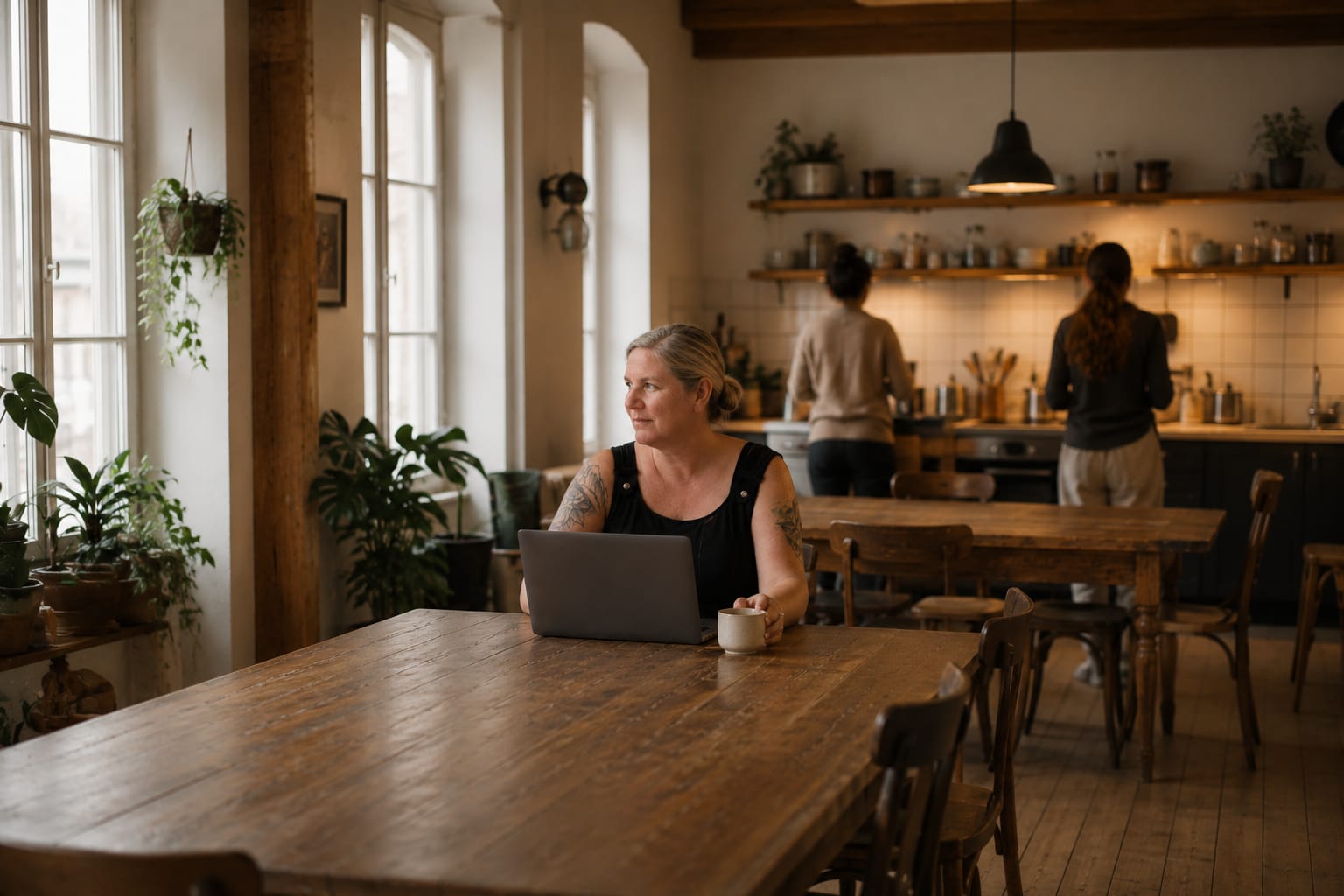
Intentional community. Coliving. Cohousing. Arrangements where you keep your own space (your own door, your own bed, your own quiet) inside a structure you don’t have to manage on your own. I’m talking shared kitchens and common rooms, group meals when you want them and solitude when you don’t. People who clock it when they haven’t seen you in a day and knock to make sure you’re okay.
It sits between the two boxes, and most people never seriously price it out. Coliving reads as something for students, or for the very young, or a person who couldn’t make it on their own. It’s the commune your aunt joined in 1974. Not for a competent adult in her fifties who simply doesn’t want to eat every dinner across an empty table.
The census only has boxes for who you’re related to and who you’re married to. It has no box for the people you share a hallway and a life with by choice. That arrangement barely shows up in the data, which is part of why it barely shows up as an option in anyone’s head.
We measure the two things we already believe are the choices, and the measurement just confirms the belief.
Four and a half million people got sorted into “alone.” I’d bet a real share of them never wanted the empty apartment. They wanted out of the couple, or never found one, and “alone” was simply the only other box on the form.
There is another box, and it’s not what you might have been led to believe it is.
