



You've been thinking about a project. Maybe it's a publication, a small business, a consulting practice, a digital product, a local venture, a creative collaboration. You can see the shape of it. You can see why it would work.
What you can't see is how you'd actually build it on your own, because the project needs capabilities you don't have — or shouldn't have to develop from scratch.
So the thought arrives: what if I built this with someone?
And then, almost immediately, the next thought that kills it: but that means forming a company together, and that’s a whole legal thing, and I don’t even know if this person would want to, and what if we have to split everything fifty-fifty when we’re contributing different amounts, and what if it falls apart...
That mental model is doing more damage than most people realize. It’s also wrong, or at least incomplete.
A note before going further: this piece is information, not legal or accounting advice. The structures described below have real legal and tax implications, and those implications vary by jurisdiction and depend on your specific situation. If your project gets serious, talk to a lawyer and an accountant who know your context. What follows is meant to help you understand your options and prepare for those conversations — not to replace them.
In this guide…
The Default Mental Model & Why It’s Incomplete
Partnerships Exist on a Spectrum
Why This Matters for Midlife Professionals
The Five Structures, From Lightest to Most Formal
Hybrid Arrangements Worth Knowing About
How to Choose the Right Structure
When Informal Arrangements Need to Become Formal
Practical Considerations Across All Structures
Before the Structure: The Conversation
The Underlying Principle
The Default Mental Model & Why It’s Incomplete
When most people imagine working with someone on a project, they picture a 50/50 partnership: shared ownership, shared decisions, shared bank account, shared liability. A formal business, jointly held. That structure exists, it’s a real option, and sometimes it’s the right one.
But that’s the most legally and emotionally complex version of working together — and most projects, especially in their early stages, don’t need to land there.
The mental shortcut of partnership = shared company is part of why so many promising midlife projects never get started. The reader looks at a project that would require working with someone, decides the partnership overhead is too much for what the project warrants at this stage, and quietly puts the idea down. The project dies before the structural question has even been examined honestly.
The structural question is worth examining honestly, because the actual landscape of options is much wider than the default model suggests.
Partnerships & Collaborations Exist on a Spectrum
Two people can work together on a project without ever forming a shared entity.
They can collaborate informally and bill their own clients separately.
One can subcontract to the other.
They can split revenue through a contract without sharing ownership of anything.
They can create a joint venture agreement that defines the project as a shared effort without creating a new company to hold it.
Or they can form a partnership, an LLC, a corporation — the formal structures most people associate with the word partnership — when the project genuinely warrants the overhead.
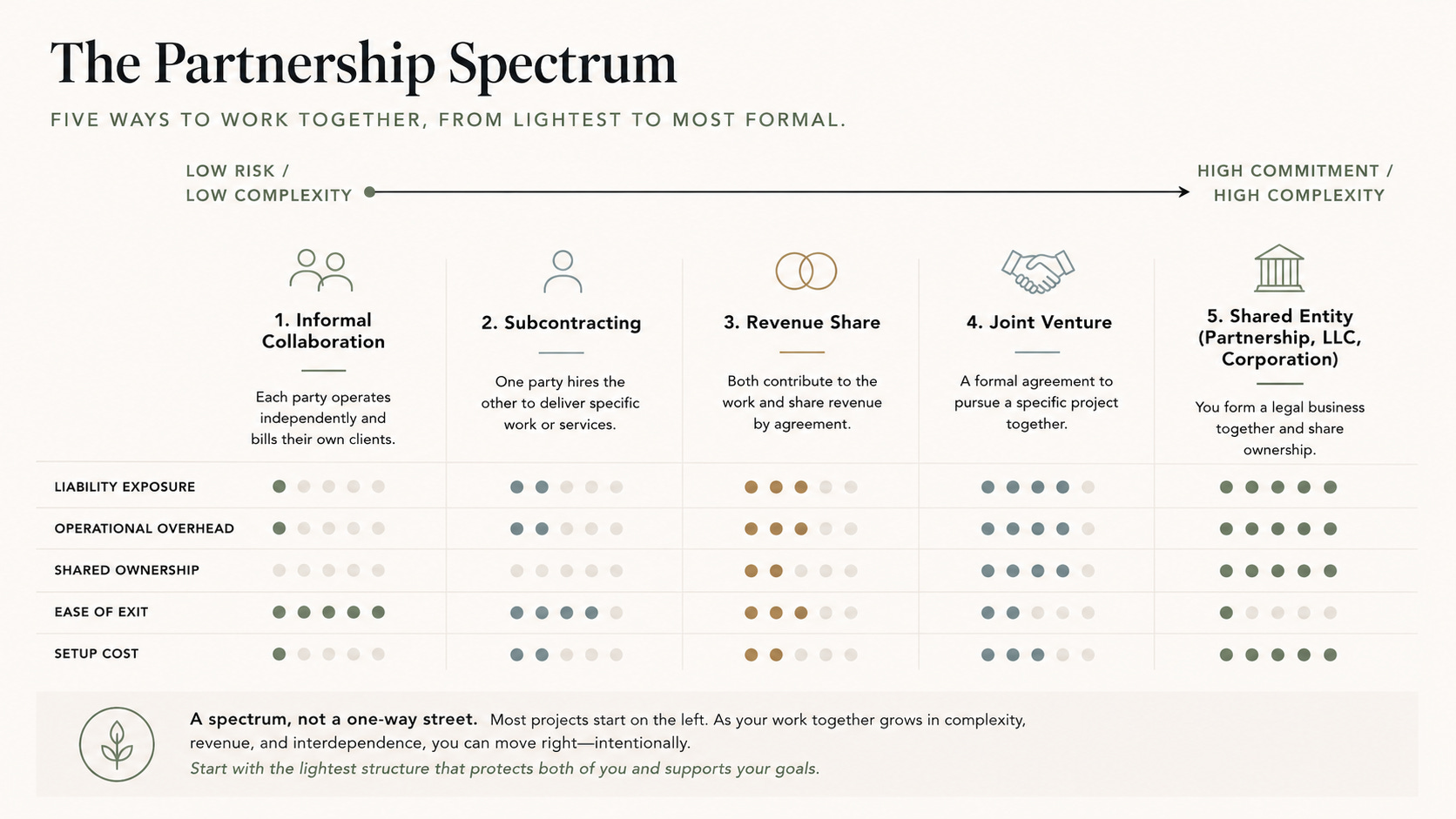
Each of those options has different implications for legal exposure, tax treatment, brand ownership, exit terms, and how the work actually gets done day to day.
None of them is universally right.
The structure that fits depends on what the project is, what each party is bringing, what they need from the arrangement, and what stage the project is at.
For most projects in their early stages being undertaken by experienced people, the lighter end of the spectrum is the right place to start. You don’t have to begin with shared ownership of a company.
You can begin with a clear conversation, a written agreement that names what each person is doing and what each person is getting, and a structure that lets the project develop before it requires the legal apparatus of a formal entity.
Why This Matters for Midlife Professionals
The default mental model is particularly costly for midlife professionals, because it kills projects that would otherwise be viable. The reader looking at a potential project usually has something younger founders don’t: a network of other midlife professionals with built-up expertise, often quietly looking at the same kinds of questions.
The right partner for the project you’ve been thinking about may already be in your contacts.
Underneath the reluctance to have that conversation is a structural concern most partnership advice fails to address: shared liability.
A formal partnership or jointly-owned company means each partner is exposed to the consequences of the other’s decisions, debts, and mistakes. If your partner makes a bad call, you’re on the hook for it. If the business takes on debt, both your names are on it. If something goes legally wrong, both of you are named.
That risk is real, and it scales with what you have to lose. A 25-year-old with no assets has limited exposure to shared liability. A 55-year-old with a house, retirement savings, and twenty more years before they can replace lost capital has a lot more at stake.
The instinct to be cautious about formal partnerships in midlife isn’t timidity. It’s accurate risk assessment.
The point of this article isn’t to argue that formal partnerships aren’t risky. The point is that you don’t have to start at the formal end of the spectrum.
Lighter structures exist that let two people work together without exposing each to the other’s liability — without shared debts, shared legal exposure, or shared ownership of an entity that survives them. Those structures are where most midlife projects should start, and many can stay there indefinitely.
What follows for paid subscribers is a walk through the actual structures, how each one operates, when each fits, what the trade-offs are, and the threshold at which informal arrangements need to become formal.
It includes how to think about IP, brand ownership, exit terms, and dispute resolution, and a worked example using a partnership I’m actually in.
