



You’ve been talking to someone about a possible partnership. The conversations have been good. The thinking is sharpening. Within a few weeks, you’re discussing formal structures, splitting equity, signing agreements.
And then, often within six months, the partnership falls apart. Sometimes spectacularly, with hurt feelings and obligations that take months to untangle. Sometimes quietly, with one party drifting away and the other left holding more of the work than they signed up for.
Either way, the time and money are spent, the relationship is damaged, and the project is now harder to attempt with anyone else.
Most of these failures share a single underlying cause:
The work that should have happened before any structure was designed never happened, or happened too late.
That work isn’t legal work. It doesn’t require a lawyer, an accountant, or an entity registration.
It’s the practical work of figuring out whether the partnership you’re imagining is actually the partnership the other person is imagining, and whether the two of you can actually work together at the pace and pressure a real venture requires.
This piece walks through the early, exploratory steps that help separate partnerships that hold up from partnerships that don’t: the conversation that has to happen before any structure gets designed, the test run that validates what the conversation reveals, and an honest debriefing that informs what you can take forward for legal and accounting support.
This is all available to you before any binding agreement exists. Both cost almost nothing to do well. And both filter out the partnerships that would have failed in the first year of a more formal arrangement — which saves enormous time, money, and relationship damage on the other side.
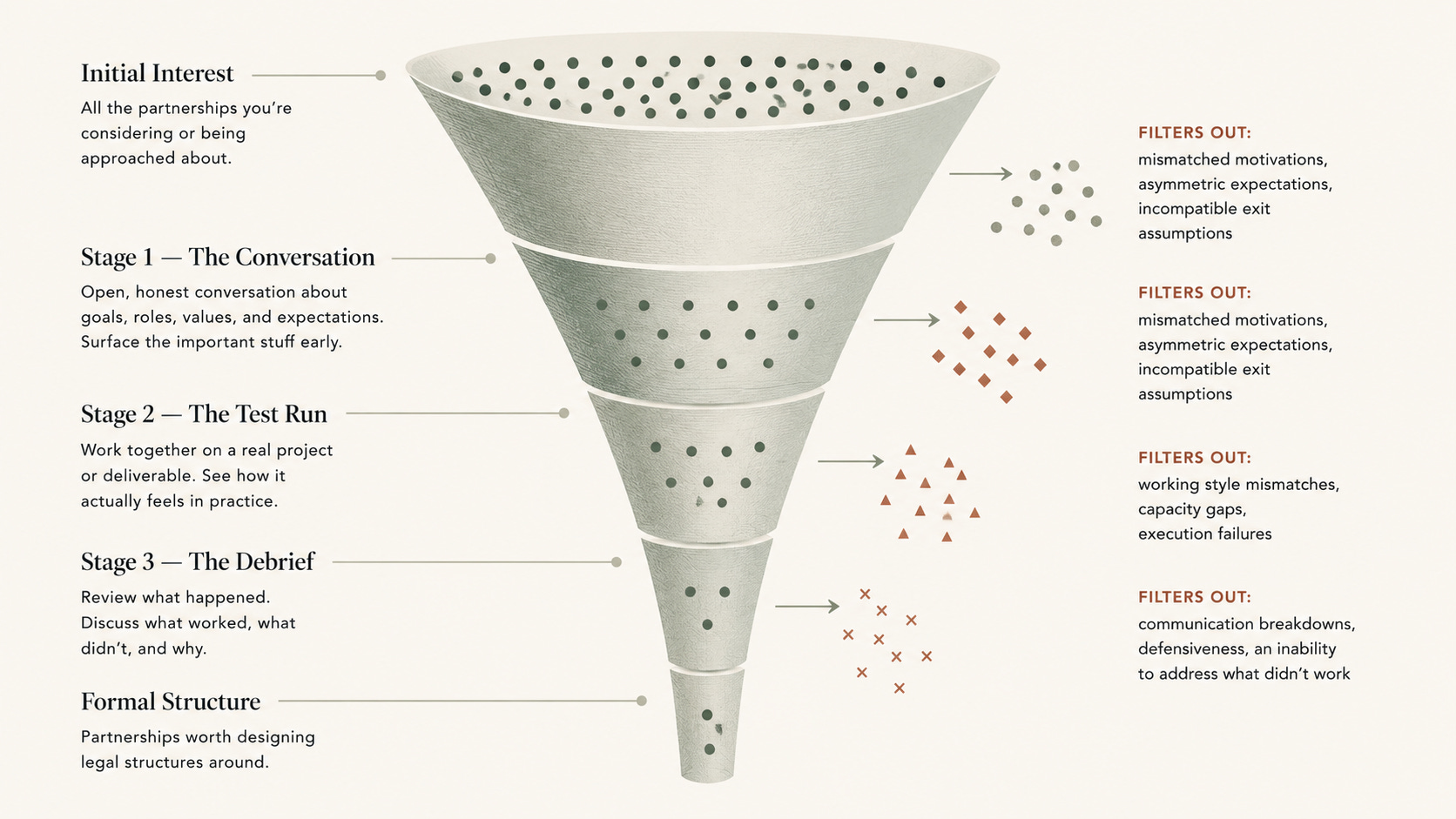
The Conversation
The hardest part of a good partnership isn’t the structure. It’s the conversation that has to happen before the structure gets designed.
Most projects fail not because the legal arrangement was wrong but because the parties never had an honest conversation about what they were actually agreeing to.
They had a vision conversation, full of enthusiasm and possibility. They had a logistics conversation, working out who would do what.
But they didn’t have the harder conversation about asymmetries, motivations, capacity, and exits. Those unspoken questions surfaced later, under stress, when both parties had already invested too much to walk away cleanly.
A few questions worth working through with a potential partner before anyone starts drafting anything:
What Is Each of Us Actually Bringing?
Be specific. Not experience or expertise — what concrete capabilities, time, capital, network, brand, or work product is each person contributing?
This is the question most partnership conversations skip, because the answer is usually less symmetric than both parties are comfortable acknowledging up front.
One party is bringing twenty years of established client relationships and a recognizable name in the industry. The other is bringing operational discipline and the willingness to do work the first party doesn’t want to do.
Those contributions are both valuable. They’re not equal in any easily measurable way, and treating them as if they are creates the conditions for resentment later.
The answers usually reveal asymmetries that need to be acknowledged, and revealing them now is much easier than negotiating them under stress when one party feels they’re contributing more than they signed up for.
