

How to Choose the Right Coliving: A Midlife Traveler's Guide
Choosing a coliving in midlife means knowing what to look for and what to walk away from. A practical guide to evaluating properties, spotting red flags, and finding the right fit.


For travelers in midlife who’ve decided coliving might be the right shape for an upcoming stay, the next question is usually the harder one: how do you actually choose the right coliving?
The format has grown enormously in the past decade, and the quality range has grown with it. Some properties are exceptional, run by hosts who’ve been at it for years and know what they’re doing. Some are mediocre. Some are converted hostels with a new sign on the door and the same bunk beds they’ve had since the summer of ‘92.
The differences matter, especially as we age. A traveler in their 20s can usually salvage a mediocre coliving stay through sheer flexibility and the energy to make any situation work.
A traveler in their 40s, 50s, or beyond — who likely has refined preferences, less interest in slumming it, perhaps a job or business to hold down, and a clearer sense of what makes a stay feel worth the time and money… well, that person needs more from the property itself.
Choosing well isn’t fussiness; it’s how this kind of travel actually pays off.
This guide is for those of you in active research mode; those who’ve narrowed down a region or a destination and are now comparing specific properties, reading reviews, scanning websites, and trying to figure out which place is actually going to deliver the stay they’re imagining.
It covers what to look for in a well-run coliving, the red flags that signal a property worth skipping, and the questions worth asking before you book.
What to Look For in Quality Colivings
A clear sense of who the property is for. Well-run colivings know their audience and say so on their website. They name the age range, the typical guest profile, the kind of work people usually do there, whether they cater to couples or skew toward solo guests, whether the social culture is high-energy or quiet. A property that’s vague about who it’s for is usually vague about a lot of other things too.
Real reviews from real guests. Look for detailed reviews on the property’s own site, on Google, on coliving directories, and ideally on personal blogs or Substack posts from people who’ve actually stayed. Marketing photos look the same everywhere; a guest writing about their actual experience is the only way to know what the property is really like. Be especially attentive to reviews from guests in your age range, since the experience can differ meaningfully across generations.
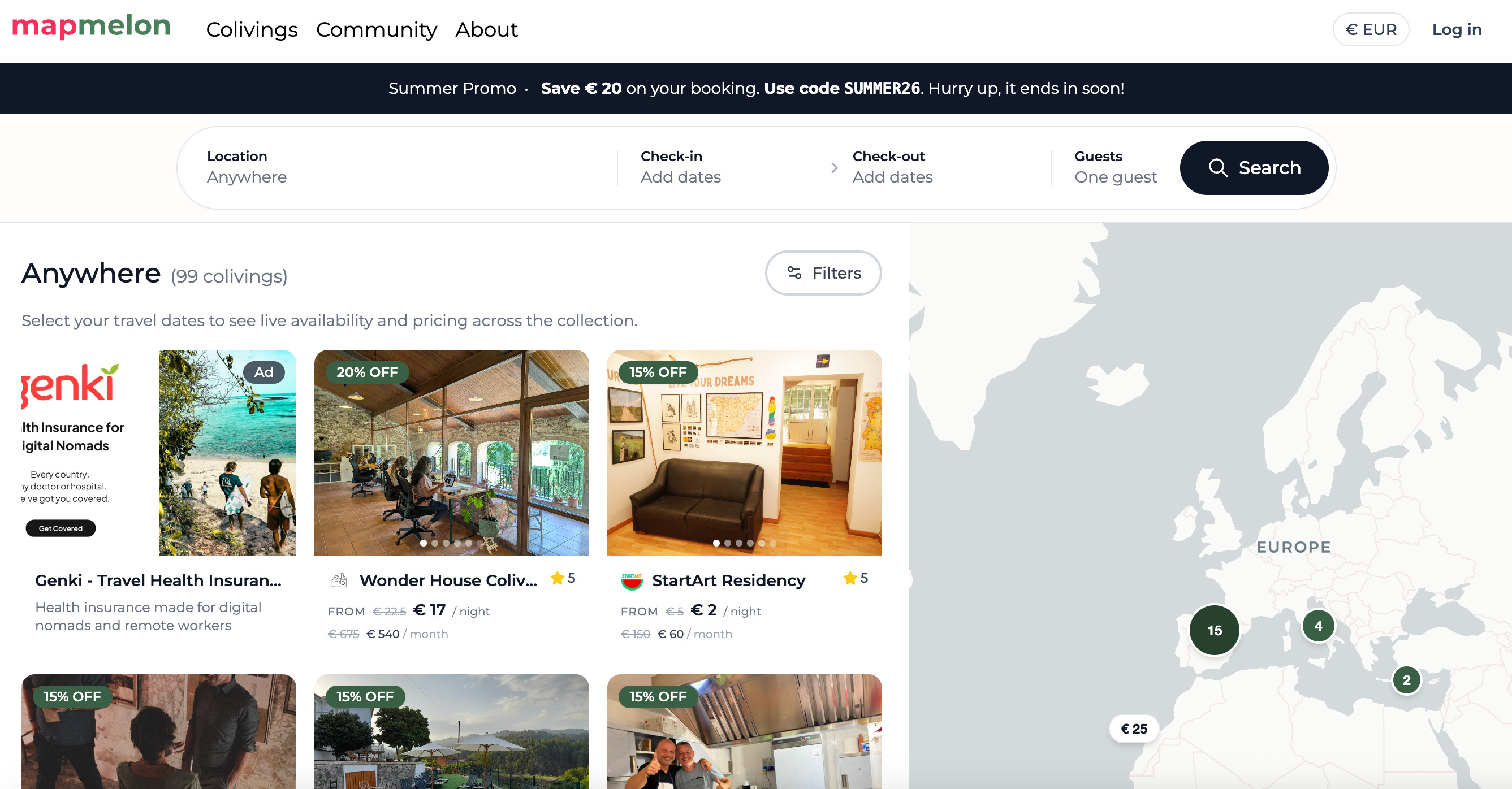
A working website with current information. Coliving is a hands-on business, and properties that can’t maintain a current website often can’t maintain other things either. If the calendar shows availability from two years ago, the photos look like they’re from a different property, or the pricing requires emailing to find out, those are signals worth taking seriously.
Private bedroom, ideally private bathroom. Most well-run colivings offer private bedrooms as a default and private bathrooms as either default or option. If a property is selling shared bedrooms or shared bathrooms as the standard, it’s either a hostel rebrand or operating at a lower tier than what most midlife travelers want.
A real workspace, if remote work matters to you. A “workspace” that’s just the kitchen table at peak meal hours doesn’t count. Look for dedicated work areas with reliable seating, good lighting, and Wi-Fi that’s been tested under load. If the property hosts remote workers regularly, the workspace should reflect that.
Honest information about meals. Some colivings include all meals, some include a few shared dinners a week, some include nothing. Some have a chef; some have a rotating cook; some leave guests to fend for themselves. None of these is wrong, but the property should be clear about which one it is, and the cost should reflect what’s included.
How to Think About Cost
Coliving prices vary so widely that any general statement about cost is mostly noise. A week in a budget property in Southeast Asia costs a fraction of a week at a high-end property in Europe, and both can be the right choice for the right traveler. What matters more than the absolute number is whether the price reflects what’s actually included and what comparable alternatives in the same location would cost.
A useful baseline: a coliving stay typically lands somewhere between the cost of a long-stay Airbnb and the cost of a comparable hotel in the same area, with significantly more included than either. If a property is priced well below that range, it’s worth asking what’s missing. If it’s priced well above, it’s worth asking what’s elevated — a chef, a particularly desirable location, a curated guest experience, a themed program. Both can be legitimate, but the cost should be explicable.

What to look for when evaluating price:
What’s bundled in. All-inclusive pricing is part of coliving’s appeal — utilities, Wi-Fi, often some meals, often weekly cleaning of common areas. A coliving that charges premium prices but bundles in little is usually one to skip. A coliving that includes most of the things you’d otherwise be tracking separately can be a better value than the headline number suggests.
What’s not included. Get the specifics. Are tourist taxes additional? Is laundry pay-per-use? Are dinners on weekends excluded? Are airport transfers extra? The base price tells you something; the all-in cost after extras tells you what you’re actually paying.
Per-person versus per-room pricing. This matters especially for couples. Some properties price per room (a flat rate regardless of one or two occupants); some price per person. The same property can be a great deal or a poor one depending on which structure applies.
The cost of comparable alternatives. Before booking, look at what a long-stay Airbnb in the same area would cost for the same dates, and what a mid-range hotel would run. Coliving makes sense when it delivers something the alternatives don’t — community, a curated property, included amenities — at a price that’s in the same neighborhood. If the coliving is much more expensive than the alternatives and not delivering meaningfully more, the math is off.
Discounts for longer stays. Many colivings offer significantly lower per-night rates for stays of two weeks or a month versus a week. If you have flexibility on length, ask. The per-night cost of a three-week stay can be 30–40% lower than a one-week stay at the same property.
Cost in coliving isn’t usually the deciding factor — quality and fit matter more — but it’s the factor that tells you whether a property is being honest about what it’s selling. Properties that are clear about pricing, transparent about what’s included, and reasonable compared to local alternatives are usually run by hosts who are clear and transparent about everything else too.
Coliving Red Flags
These may not deter you entirely from staying, but warrant digging deeper.
A pivot from hostel branding. Properties that recently rebranded from hostel to coliving without changing the underlying setup are common in certain markets. If the building has bunk beds in any room, shared bathrooms as the only option, or a check-in process that resembles a youth hostel, the rebrand is cosmetic.

Vague pricing that depends on emailing to find out. Some legitimate properties operate this way for genuinely good reasons (custom stays, complex pricing). Most don’t. A property that won’t publish its rates is often one that adjusts them based on what it thinks the inquirer will pay, and those rates tend to favor the property.
Photos that look like marketing renders rather than the actual space. Stock-photo-style images of “the lifestyle” rather than photos of the actual rooms, common areas, and kitchen suggest the property is selling an idea rather than a place. Real photos show wear, character, and the unphotogenic angles. Marketing photos hide them.
Reviews that are all five stars and read like they were written by the same person. A property with one hundred reviews and a perfect score is usually fake. Real properties have a mix — mostly positive, occasionally critical, with reviewers writing in distinct voices about specific things. Suspiciously uniform reviews suggest curation or worse.
A social culture that sounds like it’s mandatory. Language like immersive community experience, daily group activities, we live, work, and play together is sometimes accurate and sometimes a warning. For travelers who want shared meals and a porch conversation, fine. For travelers who want the option to skip dinner and read a book without explanation, properties that pitch a wall-to-wall social schedule can feel suffocating in practice.
No information about the host or operator. A well-run coliving has someone running it, and that person is usually a meaningful part of the experience. Properties that hide the host, use only first names with no context, or present themselves as faceless operations are often either undercapitalized or being run remotely without on-site oversight.
Questions Worth Asking Before You Book a Coliving Stay
A well-run coliving will answer these clearly and quickly. Properties that dodge, take days to respond, or give vague non-answers are telling you something about how the stay itself will run.
What’s the typical age range and guest mix? Ask directly. A property that says all ages welcome without further detail may not provide the actual mix midlife travelers are hoping for.

How many guests are typically at the property at once? Capacity tells you about the social texture. A coliving that hosts six at a time feels different from one that hosts twenty, and neither is wrong — but you should know what you’re walking into.
Is there a private bathroom option? If private bathrooms matter to you, confirm in writing. Private en-suite and private bathroom on the same floor are not the same arrangement.
What’s actually included in the price? Get specifics. Which meals, how many per week, what’s on the menu, whether dietary requirements are accommodated. Whether cleaning is included for common areas, for your private room, or neither. Whether laundry is included or pay-per-use.
What’s the workspace like for someone working full-time? Ask for photos of the workspace if they aren’t already on the site. Ask about the Wi-Fi speed, whether it’s been tested under load with multiple guests on calls, and whether there’s a backup if the main connection fails.
What’s the minimum and maximum stay? Some properties have hard minimums; some are flexible. Knowing the structure up front prevents awkward conversations later.
Are partners welcome to visit during the stay? For couples where one is doing the stay and the other might join for part of it, this matters. Some properties welcome short partner visits; others don’t allow them at all.
What’s the cancellation policy? Get this in writing before paying. Coliving cancellation policies vary widely and the host’s verbal assurance isn’t the same as the written policy.
Who do guests contact if something goes wrong during the stay? Some properties have on-site staff or an on-call host. Others are run remotely with no real point of contact once you’ve arrived. The difference matters when the Wi-Fi goes down or the shower stops working at 9 p.m. on a Sunday.
What’s the social culture of the house? Ask for specifics rather than adjectives. Friendly and welcoming are universal claims; we usually have a group dinner three nights a week and a Saturday afternoon walk is information.
How a property answers these questions is information in itself. Hosts who answer clearly, quickly, and specifically are usually running properties the same way. Hosts who dodge, take a week to respond, or give marketing-coded non-answers are telling you what the stay will be like.
A Final Note on Choosing Well
Choosing a coliving is not unlike choosing any other place you’ll briefly call home. The criteria look like a checklist on the page, but in practice the decision usually comes down to whether the property feels real… whether the host writes like a person, whether the photos look like a place rather than a brochure, whether the reviews sound like guests rather than scripts.
Most midlife travelers develop a working sense of this after their first stay or two. The first coliving teaches you what to look for next time. The second one confirms or corrects what you learned. By the third or fourth, most travelers have a clear sense of the kind of property that works for them, and the kind they’ll walk past without a second thought.
Another piece worth reading before booking is What to Expect at a Destination Coliving, which covers what arrival, the daily rhythm, and the first week actually look like once you’ve chosen well. Worth reading between booking and arriving.
What to Expect at a Destination Coliving

For travelers booking their first destination coliving, the nerves usually arrive a few weeks before the stay does. What’s the host like? What will the other guests be like? Will the room actually look like the photos? Will the first dinner be awkward? What if everyone else knows each other already?
You might also like:


